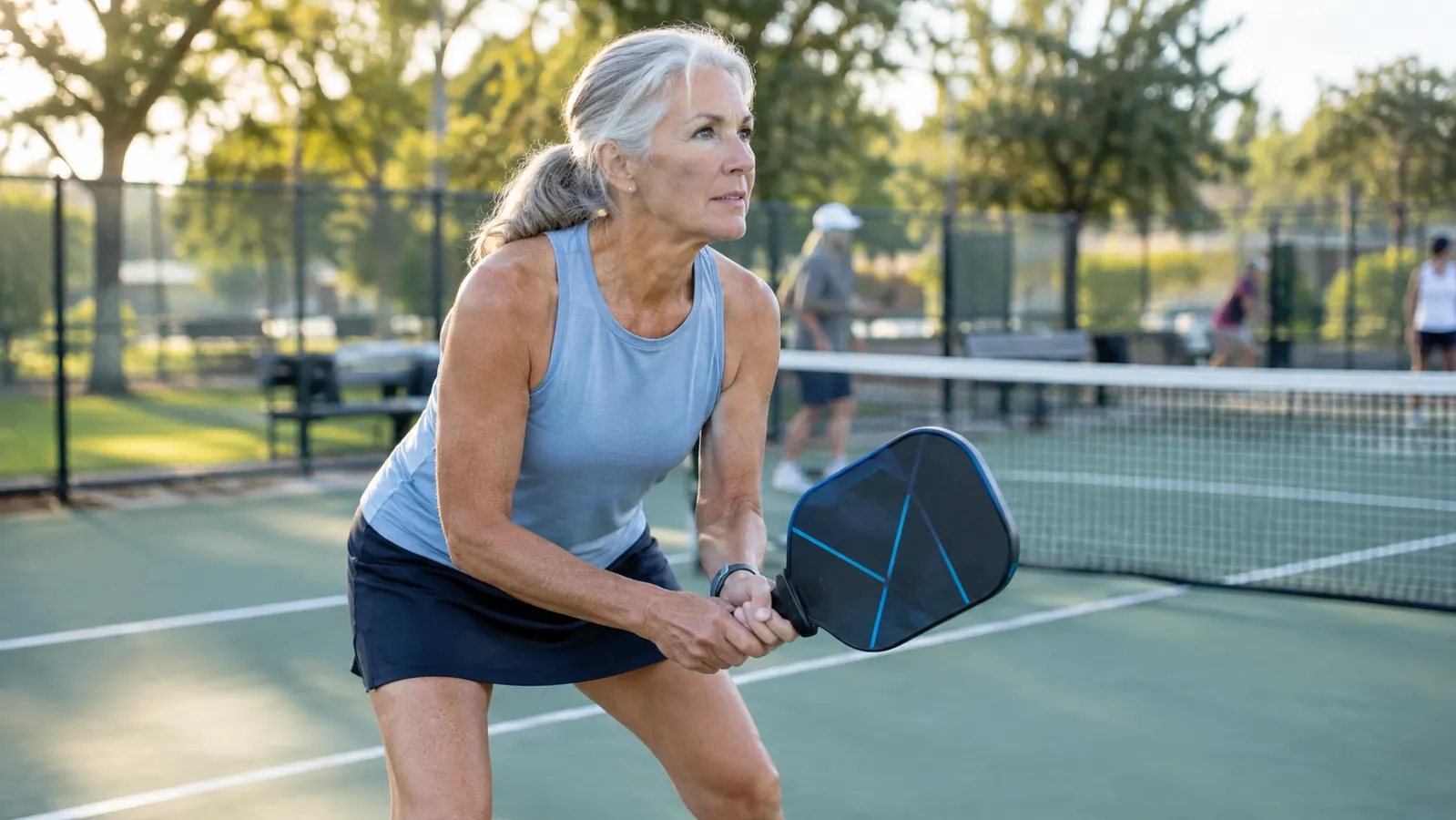
My right elbow and I have been negotiating for two winters now. It started a few springs ago, right when I turned sixty, on a third-shot drop I hit too hard because the lady across the net was grinning. My partner Carol still teases me about that swing, says I wound up like I was trying to ring a church bell. That part is funny. The part that was not funny: I spent that whole summer reaching for the ice pack every time I got home from the park. Years of hauling a clarinet case and music stands around had already given me a mild case of tennis elbow, and pickleball found it in about three weeks.
Here is what nobody told me when I started playing at my age: the paddle is not the whole problem, but it is the part you can actually fix. The right paddle cushions the hit before it reaches your arm. The wrong one sends every shock straight up your forearm like it is delivering a message. I went four months borrowing paddles from the lost and found and trying whatever was on sale, until a friend handed me a Jojolemon with a 16mm core and my elbow stopped filing complaints. I am not a gear person, and I still have to ask which side of the paddle is the backhand, so if this paddle worked for me, it can work for you. This guide is the step-by-step version of what I wish someone had walked me through before all that experimenting. If your elbow talks back after a long morning of doubles, read through these five steps before you buy anything else. The short version: weight, core, grip, balance, and ten minutes of honest dinking.
The paddle my elbow finally stopped complaining about
After four months of borrowed paddles, a 16mm carbon fiber core is what settled it. If you feel that first twinge on your third-shot drops, this is the one I would put in your bag first.
Amazon Check Today's Price on Amazon →Step 1: Sort By Weight Before You Even Look At The Brand
Buying a paddle is the exact opposite of buying shoes. You do not grab the prettiest one and hope. You start with weight, because weight is the thing your elbow feels on every single shot. A paddle that is too light, under about 7.5 ounces, seems like the smart pick when your arm is sore. But light paddles make you swing harder to get the same ball speed, and that extra swing is exactly what torques a tender elbow. Trust me, half an ounce matters more than the brand name on the face.
At the other end, a paddle over 8.5 ounces starts to feel like you are carrying a library book, and the dead weight drags on your forearm through a long doubles match. The middle band, roughly 7.8 to 8.3 ounces, is where most recreational players with cranky arms land. It is heavy enough to do the work for you on soft shots and light enough that you are not fighting it by game three. Most of the 3.5 and 4.0 players I know at the community center landed in that same band after their elbows complained.
The Jojolemon I keep in my bag lives right in that middle band. It never tempts me to muscle the ball, and it never leaves me feeling like I carried it home. When you are comparing paddles online, filter by weight first and ignore the pretty faces. Your elbow does not care about the graphic.
Step 2: Make The Core Your Second Check
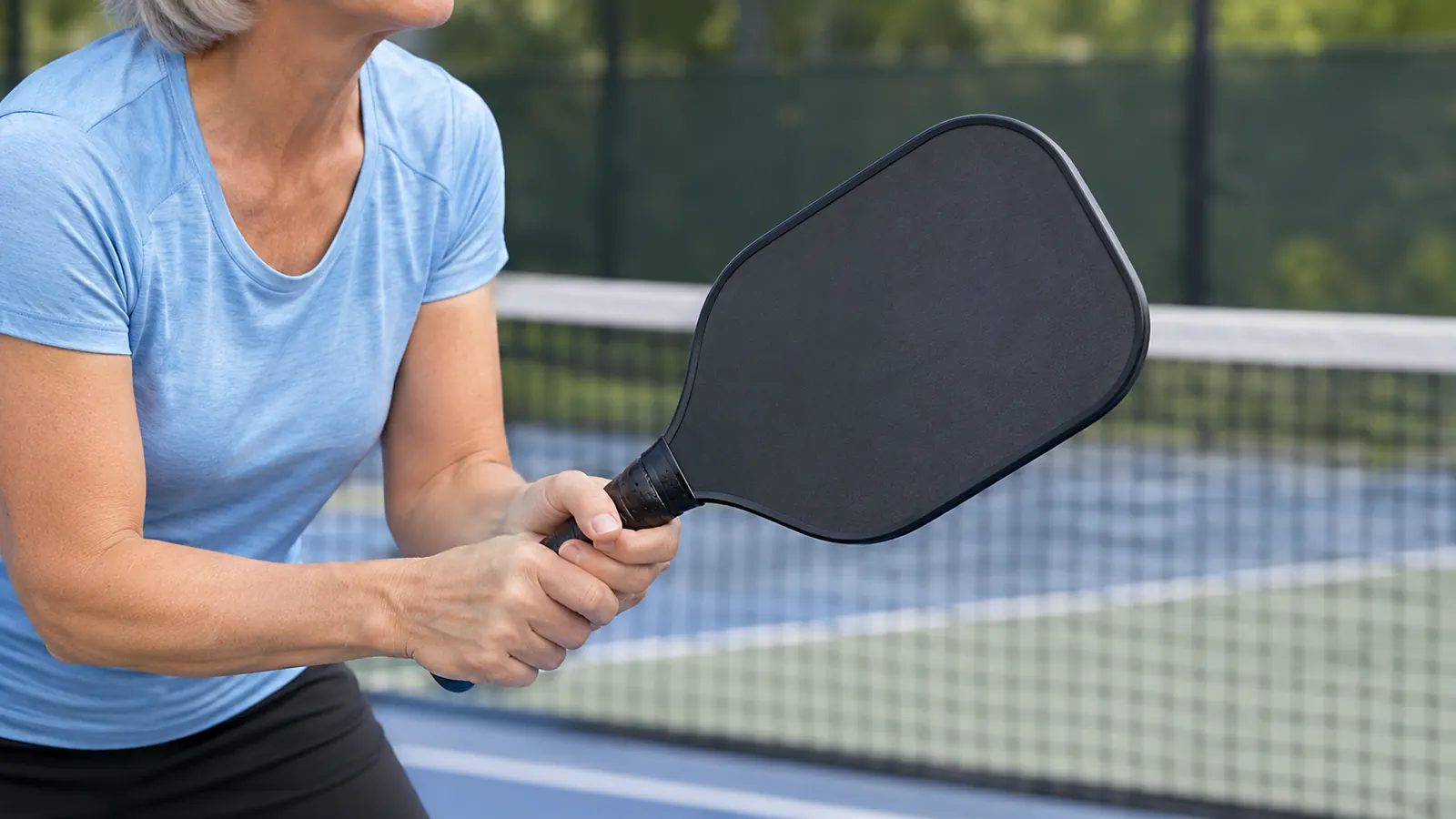
If weight is what your elbow feels on contact, the core is what it feels a split second after. Paddles have cores made of polymer honeycomb, and the thickness of that honeycomb changes everything about how the ball lands on your arm. Thinner cores, around 10 to 13 millimeters, are stiff. They pop the ball off fast, and that speed is great for aggressive players, but every bit of that pop travels straight through the paddle face and into your forearm. If that sounds technical, it is not. It is the difference between a firm handshake and a slap on the back.
Thicker cores, 16 millimeters and up, flex a little when the ball hits. That flex absorbs the shock and spreads it out over a longer moment. You get more dwell time, which is a fancy way of saying the ball stays on the paddle a heartbeat longer. That gives you softer resets, nicer dinks, and an elbow that is not catching the vibration. For anyone with a touchy joint, a 16mm core is the single most important number on the spec sheet.
The Jojolemon is built around a 16mm Shark Power Polymer Core, and that Shark Power name is mostly marketing theater. You do not need the name. You need the 16 millimeters. That is the number doing the work when you drop a soft third-shot drop and your arm stays quiet. Find that core thickness and you have already solved most of the elbow problem before you ever leave the house.
Step 3: Check Your Grip Size With Your Own Hand
Nobody ever checks grip size when they first start, and everybody pays for it. If your grip is too small, your hand has to squeeze harder to hold on, and that squeeze travels right up your forearm. It is like driving with your fists clenched for an hour. The tension builds quietly, and by the third game you feel it as a dull ache that has nothing to do with the shots you hit. For me it showed up around the second game, right when the match got fun.
The rule of thumb is embarrassingly simple. Hold the paddle in your ready position and wrap your fingers around the handle. If your ring finger digs into your palm so hard it hurts, the grip is too small. If you can slide a whole extra finger between your fingertips and your palm, it is too big. You want your fingers just barely grazing your palm when you hold the paddle loosely. That is your size. Take the two minutes to do this before you order anything.
Grips are also adjustable, which is the good news nobody mentions. You can add a heat-shrink sleeve or a cushioned over-grip to fatten a handle that feels thin, and you can remove layers to make it smaller. The Jojolemon grip worked for me right out of the box, but even if yours does not, this is the one thing on a paddle you can fix in five minutes. Do not let a too-small grip be the reason your elbow hurts.
Step 4: Look For A Balance That Keeps Weight Out Of Your Swing
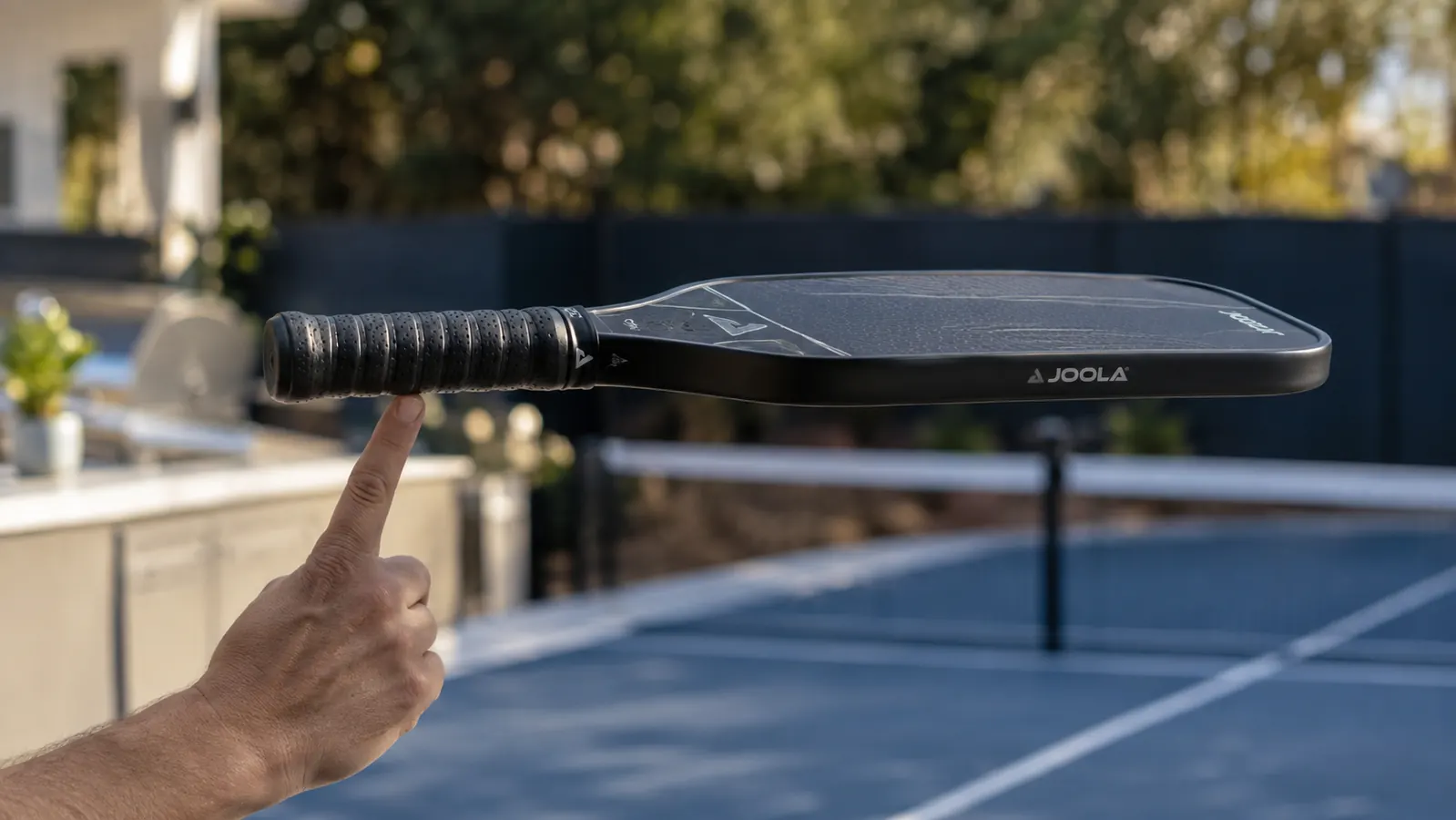
Two paddles can weigh exactly the same and feel completely different. It comes down to where the weight sits. A head-heavy paddle puts most of its mass up at the top of the face, which gives you more power on your serves and drives but swings heavier than its number suggests. A handle-heavy, or head-light, paddle puts more balance toward your hand, so it feels lighter when you swing even at the same total weight. The spec sheet will list weight, but balance you mostly have to feel.
For a sore elbow, head-light wins every time. The less mass you are whipping around at the end of a lever, the less stress you put on the joint. That is just high school physics. You are never going to outmuscle a hard drive, so let the paddle be the thing that does not fight you when you instinctively block or reset. A balanced feel also helps you keep your wrist neutral, which is where so many elbow problems actually live. Think of it like carrying a tray of coffee. The closer the weight sits to your hand, the less your arm notices it.
I have never bothered to measure the balance point on my Jojolemon, and you do not need to measure yours either. You will know it when you dink with it. If the paddle feels like an extension of your arm rather than a hammer at the end of it, the balance is working for you. When you shop, hold whatever you are considering and do a few slow, loose swings right there in the aisle. Your elbow can feel the difference before your brain can name it.
Step 5: Give It The Dink Test Before You Commit
There is exactly one test that tells you whether a paddle will get along with your elbow, and it is not a serve test and it is not a drive test. It is the kitchen line. Stand at the line and dink with a friend for ten minutes. Then reset. Then drop a few third-shot drops. Those are the shots where a stiff paddle punishes you, because they are the shots where you are meeting the ball at the end of your arm, soft and controlled.
If your elbow starts to grumble during the dink test, the paddle is wrong for you, full stop, no matter how it looks or what the reviews say. If it stays quiet, you have found a keeper. This is the test I failed for four months with other paddles before the Jojolemon passed it. The carbon fiber face plus the 16mm core means the ball feels crisp on your paddle, not dead, but the shock that usually heads up my arm just stops at my wrist. That is not a spec sheet promise. That is what I feel on the court.
One last tip on the buying part: order from somewhere with a return policy, and play with the paddle at least twice before you decide. Your first session on a new paddle is always a little awkward, like trying on new glasses. The second session is the truth. If your elbow is quiet after two sessions and your dinks are landing softer, you are done. Go buy yourself a second one for your bag. You will probably end up loaning your old paddle to a friend whose elbow has not complained yet.
What Else Helps
A good paddle gets you most of the way, but it is not the whole answer, and anyone who tells you otherwise is selling something. I still do the old music teacher warm-up before every game, which is fifteen minutes of easy paddle swings and hip openers while the courts thaw out. Cold muscles and a stiff paddle are a terrible combination. Warm up first, whatever paddle is in your hand. I am the last person to give fitness advice, so take this in the spirit it is offered: it works.
I also stopped swinging like I was ringing a church bell. That sounds like a joke now, but the real fix was form. Most of the power in pickleball comes from your legs and your shoulder, not from your forearm. When I stopped trying to arm the ball, my elbow stopped complaining louder than the scoreboard. Rehearsing a soft reset in your own living room against a wall for ten minutes a day does more for a sore elbow than any paddle upgrade.
And if the ache still shows up, respect it. I keep a simple compression sleeve in my bag for tournament mornings and I ice when it asks for ice. The paddle does the daily work. The rest of the routine keeps me on the court four mornings a week, which is the whole point. It is not about playing through pain. It is about playing smarter so you can keep playing at all.
The morning I switched to the 16mm core, I noticed halfway home that I had not once thought about my elbow. That was two winters ago.
Your elbow will tell you when it is right, usually around game two
The Jojolemon 16mm is the paddle that quieted my arm after four months of trial and error. If you are tired of the ice pack ritual, start here and give it the dink test.
Amazon Check Today's Price on Amazon →