I keep a cracked Franklin X-40 in my mesh bag. Not because I'm sentimental, though I am, a little. I keep it because it's the best proof I own that these balls are both genuinely good and honestly flawed. It split along the seam on a 38-degree October morning at the neighborhood park courts, on about the third hit of warm-up, which felt like a personal insult at the time. Now here's the thing about that cracked ball. It had already survived three months of four-morning-a-week doubles, through rain, heavy dew, and a full Wisconsin summer, and it only gave up once the temperature dropped below forty. That tradeoff is the honest story of the Franklin X-40, and it is the part that almost nobody tells you. So let's talk about it.
Here's what I think you're really asking when you search for a Franklin X-40 review. You've seen these balls in tournament highlights and sitting in every serious player's bag. You want to know if they live up to the reputation, or if you'd be just as happy with whatever is on sale at the big box store. I can't make that call for you. What I can do is tell you exactly what nine months of these balls taught me: the cracked plastic, the lost points, the games that made me want to keep playing. Then you can decide from there.
The Quick Verdict
The ball most tournament players reach for, and the reason is simple. It bounces true first, it stays round second, and it survives a real summer. Just don't ask it to survive a Green Bay November, because it won't.
Amazon Check Today's Price →The ball I reach for first whenever the weather cooperates
I've gone through six tubes in two seasons and I keep coming back. It's the ball you'll see in every tournament bag, it's USAP approved, and it plays the same on Wednesday as it did on Saturday. Check today's price on Amazon.
Amazon Check Today's Price on Amazon →How I've Used It
About four years ago, a friend dragged me to the community center and put a paddle in my hand. I was fifty-seven, I had spent thirty years as an elementary school music teacher, and I was not built to be an athlete. My right elbow has been cranky since a lifetime of carrying instruments, so I came into this sport suspicious of gear and allergic to hype. But pickleball got its hooks in me anyway. Now I'm out there four mornings a week, indoors at the rec center in the winter and outdoors at the neighborhood park courts from May through October. I play mostly doubles, usually with my friend Carol, at a solid 3.5 level. I am never going to stand on a podium. I am also never going to stop.
For this review, I used the X-40 as my main outdoor ball for nine months. That works out to roughly a hundred and forty mornings of play, most of them doubles games that run two to three hours. We play a mix of men's and women's doubles, which means a wide range of paddle speeds and a steady drumbeat of hard drives aimed at the corners. I've hit these balls on brand-new courts and on cracked asphalt that eats cheaper balls for breakfast. I've played in a morning drizzle, in ninety-degree heat, and on cold October mornings where your hands forget their job. I've opened fresh tubes and I've kept playing with balls so worn I should have retired them for everyone's sake. We trade balls mid-game, too, so no single ball took all the punishment. Between Carol and me, I'd guess we've put well over a thousand games on these balls.
One confession before I go further. I am not a scientist and I do not keep spreadsheets. I'm the person who forgets her reading glasses at home. What I do have is a very strong memory for which balls play true and which ones fight you, plus the habit of keeping every ball that dies so I can see how it died. That is the standard I'm using here. Not lab equipment. Just a retired music teacher with a good ear, a decent eye, and a mesh bag full of evidence.

What Nobody Tells You About the Cold
Here is the thing nobody tells you about the Franklin X-40. It is a warm-weather ball. It was built for summer tournaments and bright afternoons, and it plays its best game above fifty degrees. The moment the temperature drops below that, the plastic stiffens. The ball still plays, but it plays hard. It feels like a frozen grapefruit coming off your paddle, and that is exactly when the cracks start. Every cracking story I have heard on the courts starts the same way. It was a cold morning, somebody hit a hard serve, and pop.
I've also learned to read the cracks, because they're honest. An X-40 does not crack on a lucky bounce or a fluke. It cracks when it's cold, or when it's old, or when it's been left in a car overnight in October, which I have absolutely done. In warm weather and normal play, these balls are genuinely tough. One of mine stayed in weekly rotation for five months and still rolls true. And when a ball does crack, it's not a slow decline. It's instant, a thin line running from one hole to the next, and then it's done. If you live somewhere with real winters, treat these as a three-season ball and you will never be blindsided. If you expect one ball to carry you through a full Green Bay year, you're going to be frustrated, and honestly, that won't be the ball's fault.
The noise is the other thing nobody mentions until you're standing next to it. A new X-40 is loud. That sharp crack off a hard paddle carries clear across the park complex, and your neighbors will know you're out there. Some people love it, some people hate it, and I'm firmly in the love-it camp. But a woman once walked over from the tennis courts to ask if we could 'keep it down,' so you should know what you're signing up for.
Where It Earns Its Reputation
Let me give credit where it's due. The Franklin X-40 is the ball you see at tournaments for good reasons. It's USAP approved, which matters if you ever play sanctioned events, and it's the ball that a large share of the touring pros use. The bounce is consistent straight out of the tube. When I open a fresh one, I mark it with a permanent marker the way everyone does, give it a roll on the court, and it tracks dead straight. When I hit it, it comes off the paddle with a clean, predictable response instead of a dead thud or a wild spring. For a placement player like me, that predictability is the whole game.
It's also the most consistent ball I've played as it ages, and that matters more than you'd think. Cheap balls go soft or wobbly after a few sessions. The X-40 keeps its shape. I roll every ball before a game, and the X-40s stay true for months. The holes stay clean. The surface stays smooth. What happens instead is the ball gets slick long before it ever goes out of round, and that's a kind death. It tells you in advance that it's time, instead of betraying you mid-rally with a wobble that costs you the point. That's the kind of behavior you can plan around.
And one more thing in its favor. These balls handle heat and hard sun better than any I've played. I had a tube live in my car trunk for most of July, which I do not recommend for any ball, and they came out round and ready. In that same stretch, a softer premium ball I was testing went visibly out of round after one long afternoon. The Franklins just kept rolling.
How It Compares to the Balls You're Already Playing
Nobody asks this question in the first year. You just play with whatever is in the bag. But after a while you notice there are two worlds in pickleball. There's the world of the free community-center ball, the one that came in a multi-pack with a starter paddle, and there's the world of the serious outdoor ball. The X-40 lives firmly in the second world, and once you've played a full season with it, going back is hard.
The free balls bounce like they're made of rubber eraser. They thud. They wobble in the wind, and they go out of round fast. The Franklin X-40 cuts through the air better and bounces truer, and that matters enormously for a player whose game is built on placement instead of power. My dinks are nothing special, that's just honest. But I can trust where this ball is going to land, and that trust is worth more to me than any paddle upgrade I've made in four years. The difference shows up most in third-shot drops, which is where my game actually lives.
I'll also compare it honestly to the other premium outdoor balls I've played, because I know you're wondering. The X-40 plays faster off the paddle than the softer-feeling balls in the same premium tier, and it's louder. It is not the plushest ball for touch dinking, and I won't pretend it is. What the softer balls give up is that long, true life in the bag. I've seen premium balls go wobbly after a rough afternoon in the sun. My X-40s just keep showing up.
One more outdoor note. The X-40 handles wind better than the lighter, cheaper balls I've played, and it is not even close. On a breezy morning at the park, a soft ball becomes a parachute. This one holds its line well enough that you can actually run your points instead of chasing a ball that's followed the breeze to the next court. For an outdoor doubles player, that's a real advantage, and it's one of the quiet reasons I keep coming back to it.
How to Make a Box of X-40s Last
Fair warning, I'm about to sound like a retired teacher, because I am one. These four habits probably doubled the life of my balls, and they're free.
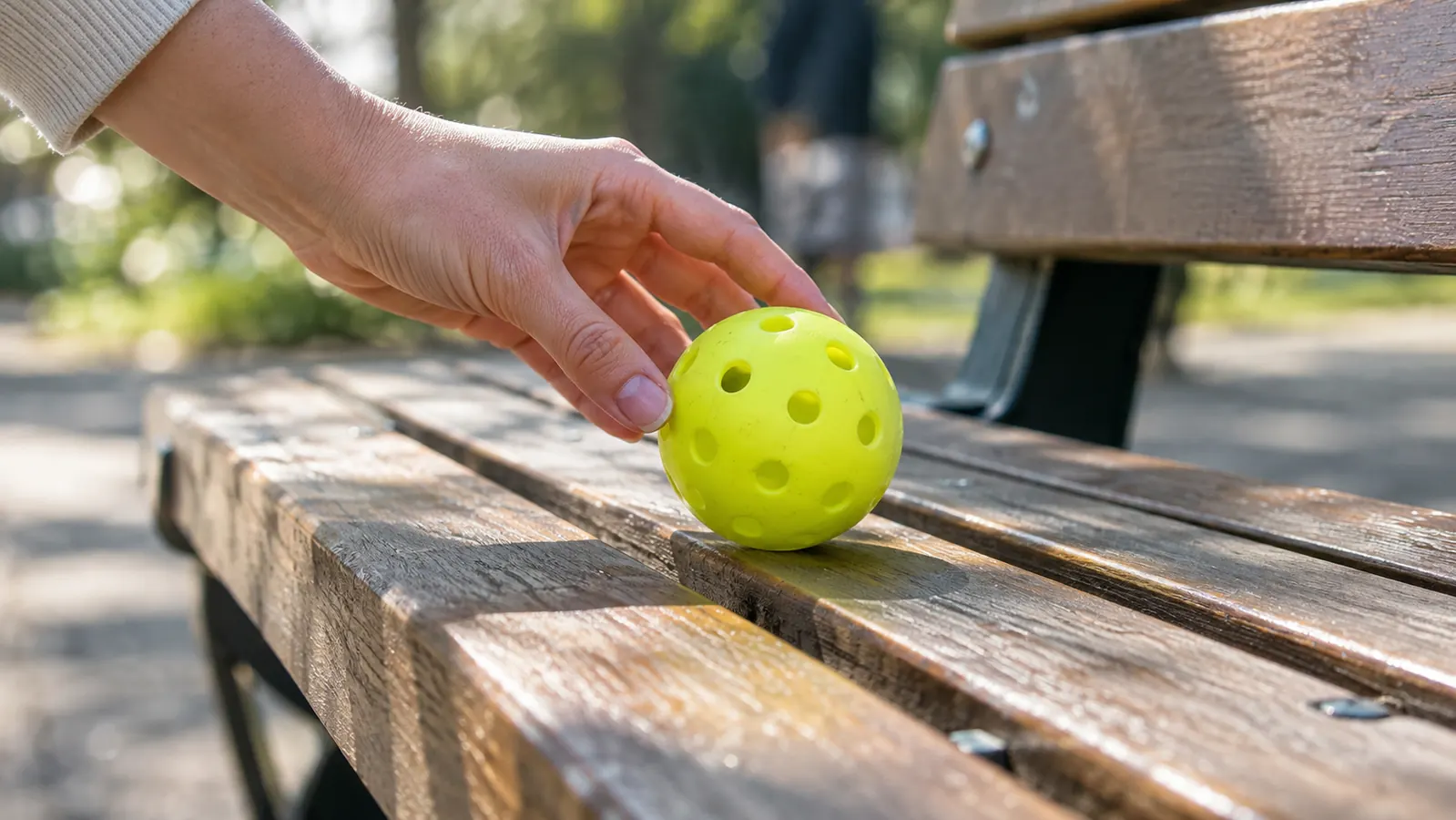
First, warm the ball up before a cold-weather game. Keep the spare tube in a jacket pocket or the glove box, not in the trunk. A ball that starts at sixty degrees instead of forty is a ball that won't crack on the first hard serve. Second, rotate through all three balls in a game instead of hammering one favorite. They wear evenly, and you get to learn each ball's personality. Third, roll every ball before you play. Set it on the court, give it a gentle nudge, and watch the seam. A wobble means the ball has earned its retirement to the practice bag. Fourth, the moment a ball cracks, pull it from play. A cracked ball doesn't just play badly. It can dive off at a weird angle and catch someone's ankle, and that's not worth saving a few seconds.
Those habits sound small, but they're the difference between a box that lasts all summer and a box that's gone by the Fourth of July. I've done it both ways, and I can tell you which one I prefer. And honestly, the habits make the game more fun, because you stop thinking about equipment and start thinking about the point.
The Bottom Line After Nine Months
So where does that leave the Franklin X-40 after nine months and well over a thousand games? It leaves it as the ball I reach for first whenever the weather cooperates, and the ball I warn my cold-weather friends about. It is not a perfect ball. There is no such thing. It is the most consistent, most honest ball in my bag, and that is a better recommendation than perfection.
If you're the kind of player who wants one ball that does everything, this isn't it. The X-40 knows its job and does it beautifully for three seasons of the year. For the fourth season, it will crack and you need a backup plan. Keep a tube for cold mornings, play your X-40s in the sun, and you get the best of both worlds.
What I Liked
- USAP approved, so it's tournament legal for sanctioned play
- Consistent, true bounce straight out of the tube
- Genuinely durable in warm weather; one of mine lasted five months
- Stays round as it ages, so it gives fair warning before it dies
- The ball most tournament players use, so practice matches real game conditions
- Holds its line in wind better than lighter balls
Where It Falls Short
- Cracks in cold weather, especially below fifty degrees
- Loud, sharp sound off the paddle; you will be heard
- Feels hard and stiff on cold mornings
- Not the softest ball for touch dinking
I kept the cracked ball because it told the truth: three months of play, a thousand games, and one 38-degree morning did what no summer could.
Who This Is For
This ball is for the player who plays outdoors most of the year and wants a ball that behaves like the tournament standard. If you're in the 3.0 to 4.0 range and you mostly play doubles on outdoor park courts, the X-40 is the sensible choice. It gives you a true bounce, honest consistency, and the quiet reassurance that when you walk into a league game, you're not the only one playing with one. It's also for the player who hates chasing wobbles and replacing balls every two weeks. Buy a box, take care of it, and it will take care of you all season long. That includes me, and it probably includes you, or you wouldn't have read this far.
Who Should Skip It
If you play indoors, this is the wrong ball, full stop. The forty-hole outdoor ball is not what you want on a gym floor, and you'll hear that on every hit. I play indoors at the rec center all winter and I use a completely different ball down there. And if you live somewhere with long winters and you mostly play below fifty degrees, you'll be frustrated by how fast these crack. I would never talk you out of buying them, but I would tell you to buy them for the months they're built for. And if you're brand new, still figuring out which end of the paddle goes up, you don't need a box of these yet. Play with whatever's free, learn the game, and treat yourself to the X-40 when you're ready to get serious.
Ready for a ball you can trust from May through October?
I've gone through six tubes in two seasons and I'll keep buying them. If you play outdoor doubles, this is the one to start with. Check today's price on Amazon, grab a tube, and I'll see you at the kitchen line.
Amazon Check Today's Price on Amazon →